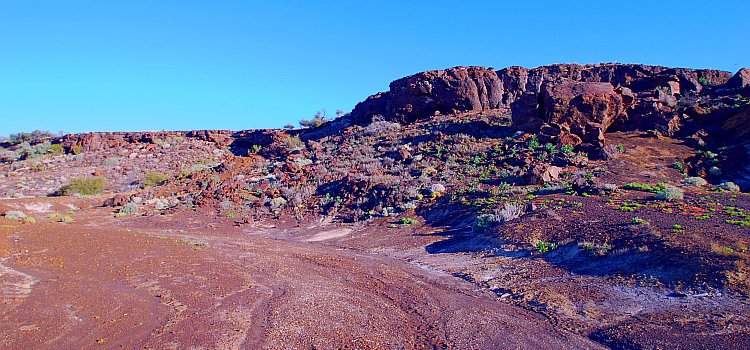
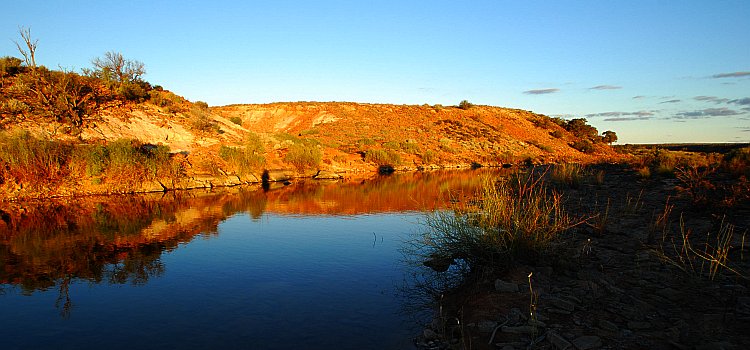
Started at 8 on the same bearing as yesterday, 230 degrees. At thirteen miles ascended a low red granite range in which there is water. Changed our bearing to 209 degrees to a hill on the opposite range; when I returned I found the grey mare so done up that she is unable to proceed. I should not like to leave her, but I cannot delay longer with her. For about half a mile under the range where we are now camped is beautiful feed up to the horses’ knees. Six cockatoos passed over to another range. We have also found a small running stream where I shall leave the mare to-morrow; I will make an attempt to regain her as I return.
Started at 8 on the same bearing for the hill on the opposite range. At six miles another low granite range with water, where we left the mare. At twelve miles went to the highest point of the range composed of hard flinty quartz and ironstone. We had a good view of the surrounding country, which was generally low and undulating, with salt lakes crossing at about ten miles. This region appears to be dotted with the lagoons from nearly the foot of the range. Changed our bearing to 268 degrees for nine miles. Camped under a range of low hills with good feed for the horses. On our west course we crossed a plain of red light soil, with abundance of grass and a little salt bush with a very thick scrub close to the range, but as we advanced it became more open, and the scrub lower. Shot a wallaby and had him for supper. Distance to-day, twenty-five miles.
Left at 8.30 a.m. on a bearing of 239 degrees to avoid the stones on the hills. At five miles and a half got some rain water; at nine miles changed our bearing to 255 degrees; at fifteen miles camped among the sand hills. Shot another wallaby. The timber about here is very large, consisting of black oaks, mallee, mulga, the native peach, the nut, and numerous low scrubs. The grass is good in some places. The mountain that I am steering for is further off than I anticipated; we got sight of it a short time before we halted; it seems to be very high, and I expect something good will be the result of our visit to it to-morrow. The hills that we were camped under last night are composed of quartz, and are connected with the range that we were on running to the south-west. Distance to-day, twenty six miles.
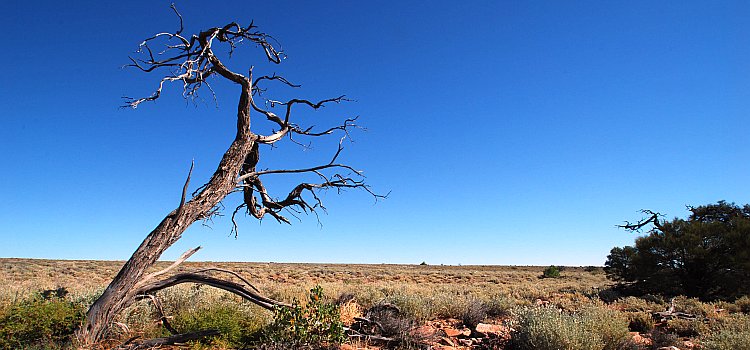
Left at 8.30 a.m. on the same bearing, 255 degrees, for eighteen miles to the foot of the mountain. At fifteen miles camped under the highest point, which is composed of quartz rock. The journey to-day has been through horrid dense scrub and heavy sand hills, to the foot of the hill, which I have named Mount Finke. It is as high as Mount Arden; I have not light to get on the top of it to-night. Very little rain has fallen here, and we have been without water for the last two nights: the country is of such a light sandy soil that it will not retain it. I almost give up hopes of a good country; this is very disheartening after all that I have done to find it. If I see nothing from the top of the mount to-morrow, I must turn down to Fowler’s Bay for water for the horses. As I could not remain quiet, I got on one of the lower spurs of Mount Finke to see what was before me. The prospect is gloomy in the extreme! I could see a long distance, but nothing met the eye save A DENSE SCRUB AS BLACK AND DISMAL AS MIDNIGHT. On my return I found that Forster had succeeded in finding water by digging in the creek. Distance to-day, twenty miles.
At dawn of day I ascended the mountain, but was unable to see much more than I did last night, in consequence of there being a mist all round. No high rising ground is to be seen in any direction. A FEARFUL COUNTRY. Left the mount at 9.30 a.m. on a bearing of 270 degrees. At eighteen miles halted to give the horses some food, as they were obliged to be tied up all last night, there not being any feed for them, and the scrub very dense. The horse Blower seems to be very unwell; he has lain down twice this morning, and an hour’s rest will do him good. After leaving the mount we have a thick mallee and mulga scrub to go through with spinifex. At ten miles changed our bearing to 190 degrees; at eight miles camped. The whole of our journey to day has been through a dreadful desert of sand hills and spinifex. In the last eight miles we have not seen a mouthful for the horses to eat and not a drop of water; it is even WORSE than Captain Sturt’s desert, where there was a little salt bush; but here there is not a vestige. Distance to-day, twenty-five miles.